Open computer vision research

Computer vision for recycling.

MIRA detects five material classes, measures uncertainty, and prepares every result for edge deployment.
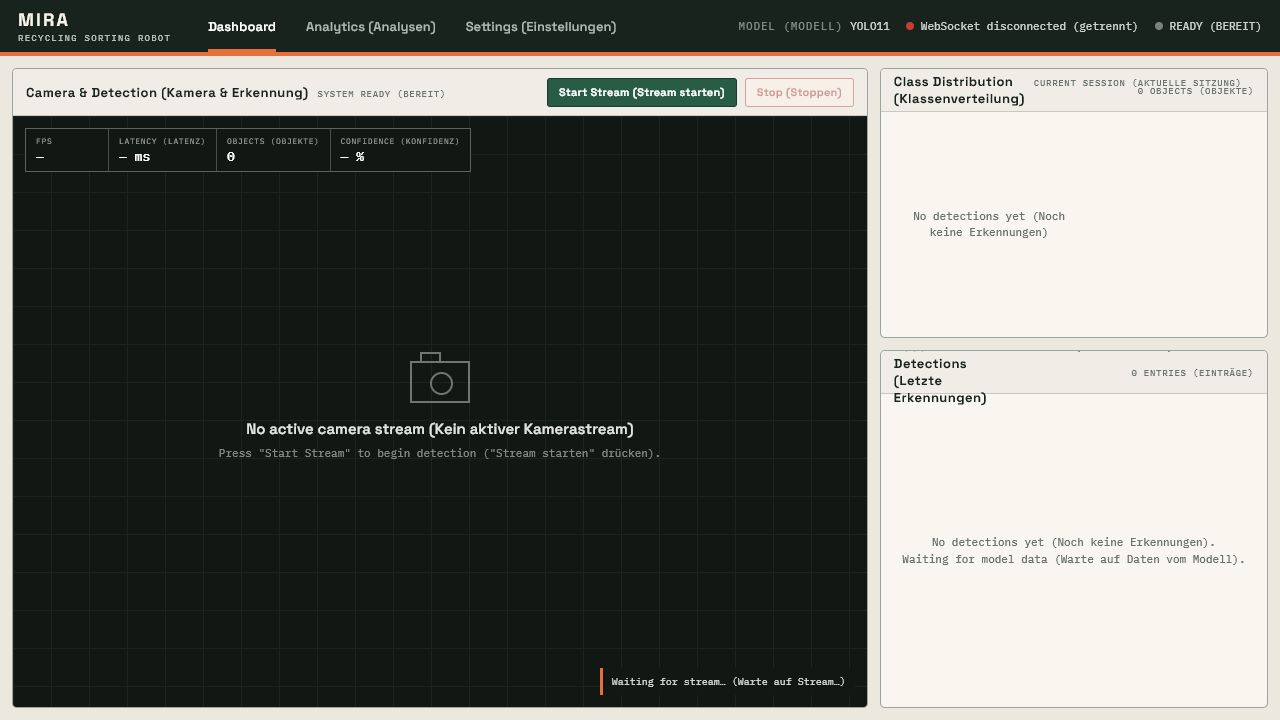
MIRA dashboard Local system
MIRA local dashboard with camera area, detection statistics, and class distribution panels
Real dashboard interface included in the repository.
90.58%EXP-019 mAP50
2.58Mmodel parameters
5material classes
308automated tests
PT + TFLiteincluded exports

From camera frame to sorting decision.

The current system handles perception end to end. Physical sorting remains the next engineering milestone.

  1. 01

    Capture

    USB and IP cameras feed a thread-safe frame buffer with reconnect and freeze detection.

  2. 02

    Detect

    YOLO or TFLite models locate glass, metal, paper, plastic, and trash.

  3. 03

    Decide

    Confidence and reject thresholds separate confident detections from uncertain ones.

  4. 04

    Observe

    The dashboard reports detections, class counts, latency, FPS, CPU, and memory.

  5. Next

    Sort

    Raspberry Pi validation and actuator integration are planned, not presented as finished.

More than a model file.

MIRA is a research toolkit for building, testing, comparing, and running recycling detectors.

Live vision

Local inference with a real operating view.

Model selection, camera controls, bounding boxes, class distribution, recent detections, and system metrics are joined in one FastAPI dashboard.

Dashboard reference
Research 19

documented experiments

Classification, detection, dataset composition, quantization, and repeatability.

Data

Deterministic dataset tools.

Merge registered sources, remap labels, validate YOLO annotations, generate manifests, and reproduce splits.

Deployment

One model, two practical formats.

.pt.tflite

Use PyTorch for development and an INT8-quantized TFLite export for edge testing.

The largest gain came from better data.

EXP-018 and EXP-019 reached 90.6% mAP50 after rebuilding the detector around a clean, balanced tabletop dataset. Architecture alone did not produce the breakthrough.

mAP50-95
82.15%
Precision
87.2%
Recall
84.6%
Training time
2.67 h
Read the complete experiment story
Stage B ยท mAP50

Detector progression

90.58%
Current through EXP-019. Values are generated from the repository experiment log.

Built, measured, and honest about what comes next.

Working now

  • Five-class object detection
  • Live USB and IP camera inference
  • Confidence reject system
  • Training and dataset pipeline
  • Dashboard and model exports

Still to validate

  • Raspberry Pi latency and memory
  • End-to-end physical sorting
  • Robustness under heavy occlusion
  • More examples of crumpled paper and end-on cans

Inspect the evidence or run the system.