Local inference with a real operating view.
Model selection, camera controls, bounding boxes, class distribution, recent detections, and system metrics are joined in one FastAPI dashboard.
Dashboard referenceOpen computer vision research
MIRA detects five material classes, measures uncertainty, and prepares every result for edge deployment.
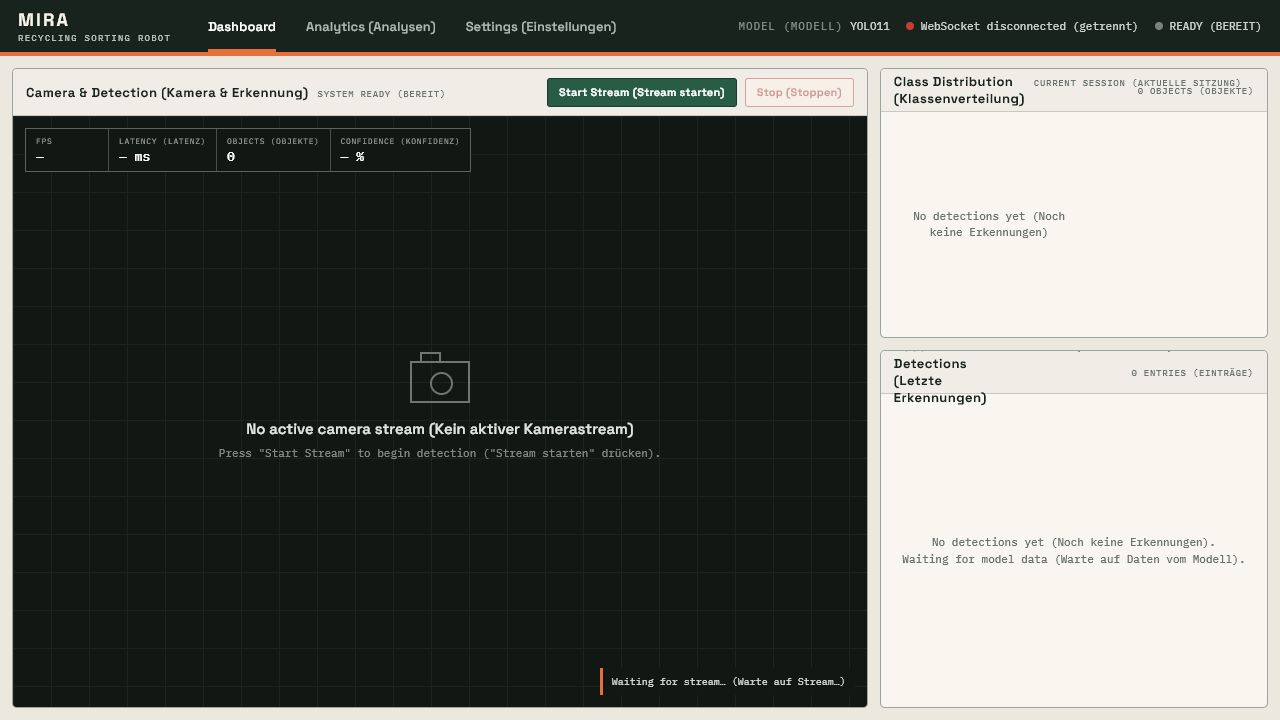
I can capture a frame, detect the materials, inspect the confidence, and review the result in one local workflow.
USB and IP cameras feed a thread-safe frame buffer with reconnect and freeze detection.
YOLO or TFLite models locate glass, metal, paper, plastic, and trash.
Confidence and reject thresholds separate confident detections from uncertain ones.
The dashboard reports detections, class counts, latency, FPS, CPU, and memory.
MIRA includes the tools I needed to prepare data, compare runs, test a camera stream, and inspect the result.
Model selection, camera controls, bounding boxes, class distribution, recent detections, and system metrics are joined in one FastAPI dashboard.
Dashboard referenceClassification, detection, dataset composition, quantization, and repeatability.
Merge registered sources, remap labels, validate YOLO annotations, generate manifests, and reproduce splits.
EXP-018 and EXP-019 reached about 90.6% mAP50 after I removed inconsistent examples and rebuilt the detector around a cleaner dataset.